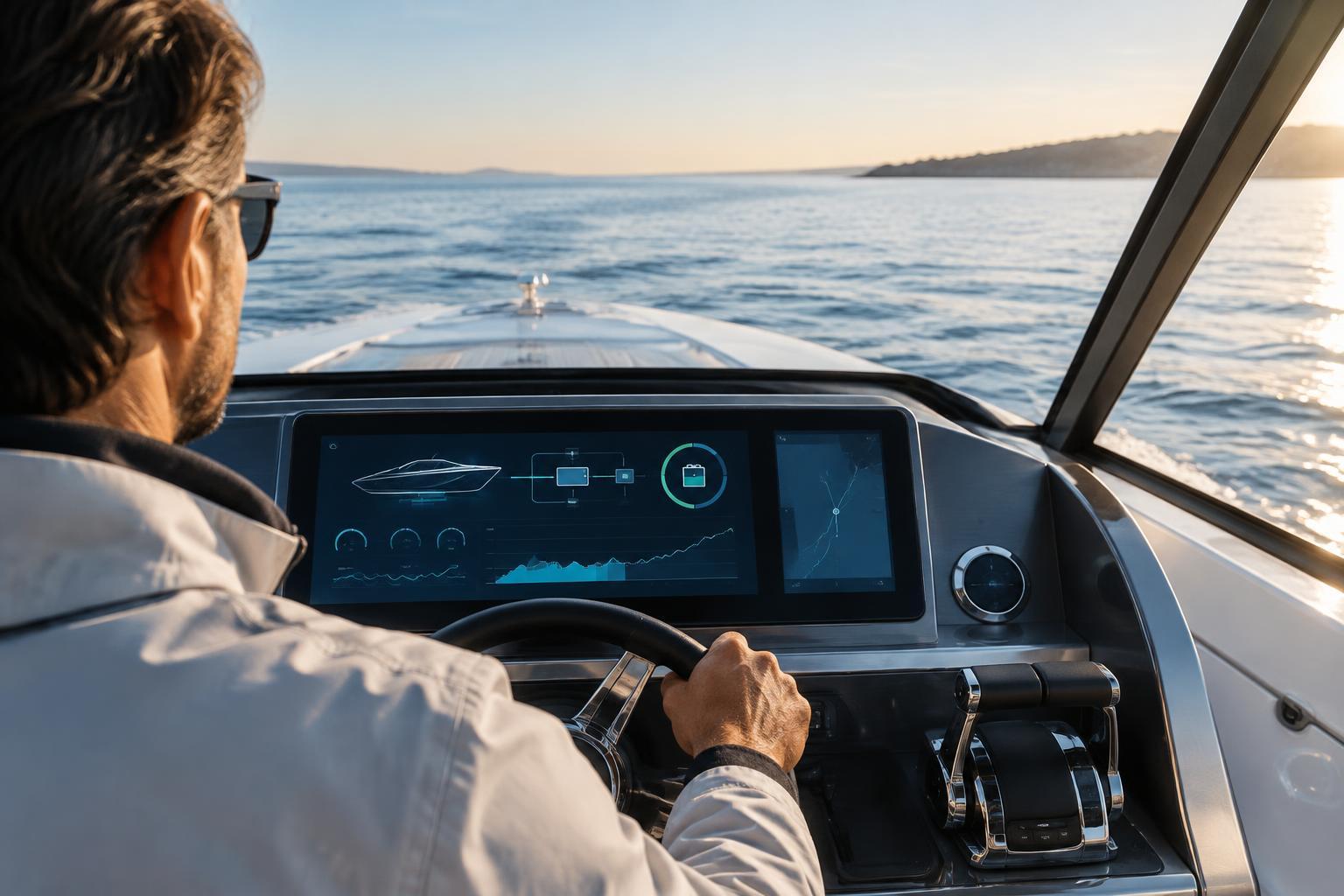
The central trade-off is simple: more battery creates more usable range, but it also adds weight, volume, cost and charging time. To answer how much battery for electric boat operation, begin with the energy required for the intended voyage—not with the motor’s headline power rating.
A battery pack must support the normal route, a sensible reserve and the boat’s real operating conditions. The resulting capacity is a system-level decision involving hull resistance, speed, onboard loads, charging access and the limits of the battery installation itself.
Start with energy, not battery capacity
Motor power is measured in kilowatts, while battery capacity is measured in kilowatt-hours. Power describes the rate at which energy is used; capacity describes the energy available over time. A high-power motor may draw little energy when manoeuvring, yet consume it rapidly when pushing a planing hull at speed.
The useful starting point is the boat’s energy consumption across its actual duty cycle: leaving berth, acceleration, cruise, periods at low speed, hotel loads and return. Hotel loads are the non-propulsion consumers such as lighting, refrigeration, navigation equipment and climate systems. On a quiet displacement passage they can become a meaningful share of total demand.
Turn the route into usable energy
Calculate the route energy first, then add the reserve appropriate to the consequences of arriving with less energy than expected. Conditions matter. Wind, waves, current, fouled underwater surfaces, passenger load and repeated acceleration can all increase consumption beyond calm-water expectations.
Next, distinguish nominal pack capacity from usable capacity. Battery management systems commonly preserve an operating window rather than allowing the full nominal capacity to be discharged. That protects battery condition and maintains operational margin. Energy also passes through cables, inverters, motors and driveline components, each with losses.
In principle, pack capacity must cover route energy plus reserve after allowing for the usable battery window and system losses. A credible proposal should show each assumption rather than presenting a single range figure without context. For a deeper view of the components involved, see how propulsion hardware works together.
Recognise the signs of a mismatch
A boat that appears to have adequate battery on paper may still be incorrectly sized for its use. The most recognisable symptom is a voyage plan that works only at one carefully chosen speed. If reducing speed slightly transforms the predicted range, hull resistance is likely dominating the energy budget, and the preferred cruise speed needs closer scrutiny.
Another warning is a large difference between expected and observed energy use on familiar routes. Check the route profile before blaming the battery: frequent throttle changes, sea state, trim, loading, cooling demand and auxiliary equipment may explain the gap. Repeated charging immediately after routine outings can also indicate that the pack was designed around best-case conditions rather than normal use.
Check the constraints that alter the answer
| Design factor | Effect on battery sizing | What to verify |
|---|---|---|
| Hull and speed | Resistance can rise sharply as speed increases | Energy use across the planned speed range |
| Battery location | Mass distribution affects trim and handling | Structural space, access and centre of gravity |
| Cooling | Heat can restrict sustained power and charging | Cooling circuit capacity in expected conditions |
| Charging plan | Available time shapes practical daily range | Berth supply, connector compatibility and turnaround time |
Battery mass and placement deserve particular attention in performance-oriented boats. Adding capacity aft, for example, may alter running attitude and increase resistance, which partly erodes the range the additional battery was intended to provide. The battery, hull and propulsion system should therefore be assessed as one package.
Set the design decision before selecting hardware
Define the voyage that must be completed reliably, the reserve that remains untouchable in normal planning, and the charging opportunity available before the next departure. Only then is it sensible to compare battery architectures, motor ratings and charging equipment. Aqualith Marine can support this process through marine battery integration, hydrodynamic optimisation and propulsion engineering.
Before proceeding, verify the measured energy consumption of the intended route at the speed you genuinely expect to use.
Leave a Reply