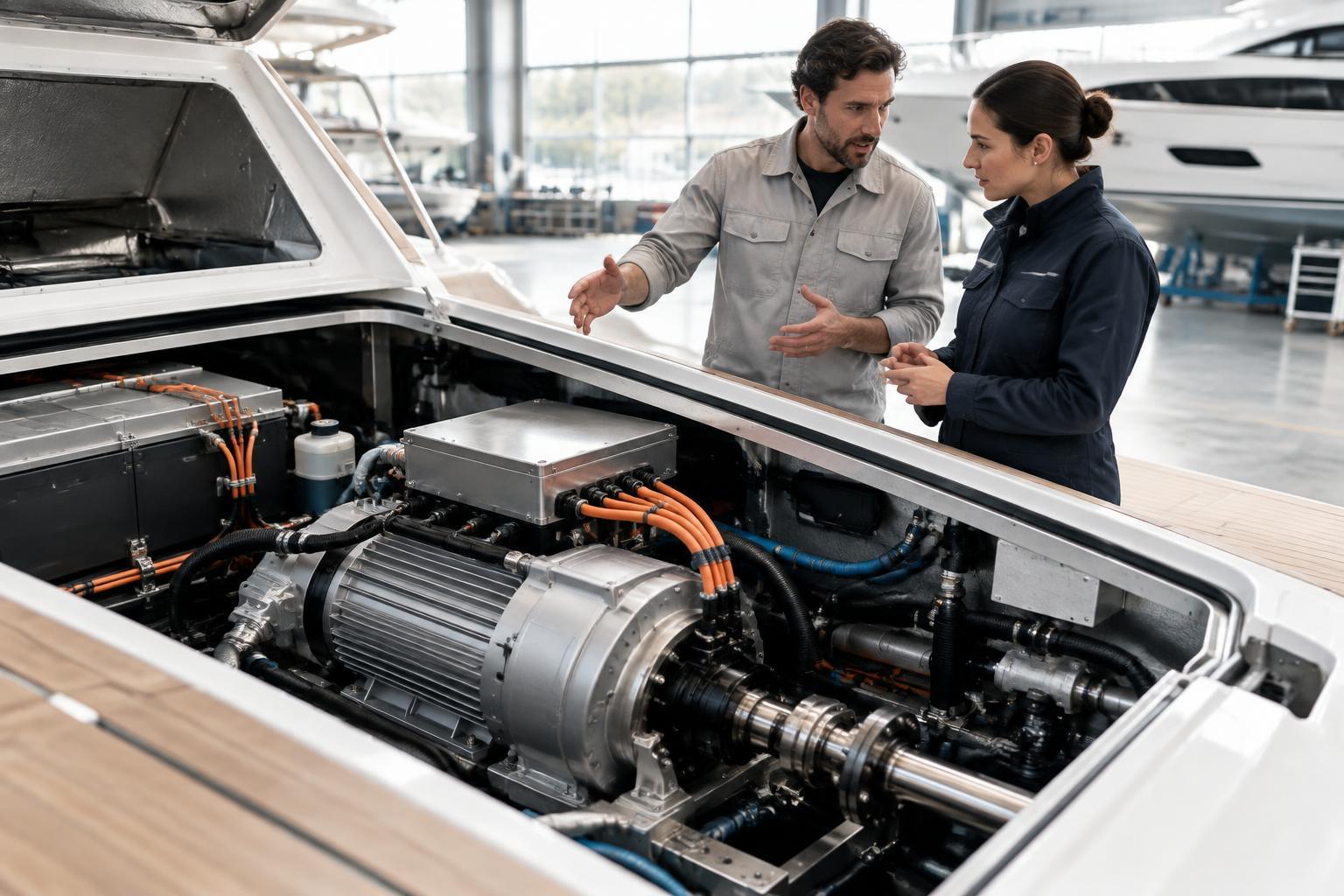
Electric yacht powertrain engineering is the process of designing the battery, power electronics, electric motor, driveline, cooling and control systems as one integrated propulsion system. A successful design starts with the yacht’s real operating profile, because speed, hull resistance, onboard loads, charging access and expected time underway all affect the architecture.
A powertrain is more than an electric motor
It is tempting to frame an electric conversion or new-build project around motor output alone. In practice, the motor is only one part of an energy chain. Stored energy leaves the battery through protected high-voltage cabling, is conditioned by an inverter, converted into mechanical torque by the motor and delivered to the water through a shaft, saildrive, pod or other propulsion arrangement.
Each interface needs deliberate engineering. The inverter controls motor speed and torque, while the battery-management system monitors cell condition and helps keep the battery within its intended operating limits. Contactors, fuses, isolation arrangements and emergency shutdown functions form part of the high-voltage safety strategy. The arrangement must also accommodate service access, cable routing, vibration, moisture exposure and the yacht’s structural layout.
This system view distinguishes a credible engineering brief from a component-shopping exercise. A technically capable motor cannot compensate for insufficient usable energy, a mismatched propeller, restricted cooling flow or a hull that demands too much power at the intended cruising speed.
Begin with the operational brief
Powertrain requirements should be defined before selecting equipment. The brief should establish whether the yacht is intended mainly for quiet harbour movement, day cruising, extended displacement passages, performance-oriented use or a mixture of these conditions. It should also identify hotel loads, meaning the electrical demand from equipment such as climate control, lighting, galley systems, navigation electronics and domestic appliances.
These demands matter because propulsion and hotel loads often draw from the same energy reserve. A design that appears suitable when considering propulsion in isolation may provide a different onboard experience when auxiliary consumption, reserve expectations and charging time are included. Environmental conditions also matter: sea state, water temperature, fouling, wind and payload can materially change energy use.
For this reason, projected range should be treated as a scenario rather than a fixed promise. It depends on how the yacht is operated and maintained, as well as the route and available charging infrastructure. Early modelling can clarify these trade-offs before machinery spaces, battery locations and charging arrangements are committed.
Engineering the energy storage system
Marine battery integration involves more than fitting modules into unused volume. Battery mass affects displacement, trim and structural loading, while the location of that mass influences stability and motion. Designers must balance a low, protected position with ventilation, access, separation from heat sources and practical installation routes. The enclosure and surrounding structure must be considered as part of the yacht, not as an afterthought.
Thermal management is equally important. Batteries, inverters and motors generate heat when delivering or accepting power, and marine environments add challenges including salt air, confined compartments and changing water temperatures. Liquid cooling, air cooling or a combined approach may be appropriate depending on the equipment and duty cycle. The selected approach must manage heat reliably without creating unnecessary complexity or new maintenance burdens.
Charging architecture should be reviewed at the same stage. Shore-power capability, connector compatibility, onboard charging equipment and expected turnaround time need to align with the owner’s likely berthing and itinerary. Where local electrical or maritime requirements apply, the project team should verify the applicable rules with the relevant authorities and classification bodies rather than assuming a generic arrangement is acceptable.
Motor, driveline and propeller matching
High-performance electric motors provide immediate torque and precise control, but their benefits depend on correct matching. A direct-drive system can reduce mechanical complexity where motor speed suits the propeller. A reduction gearbox may be justified when it allows the motor and propeller to operate more efficiently across the required duty range. Pod and saildrive arrangements can simplify some packaging decisions, while conventional shaft systems may better suit other hull forms, service preferences or refit constraints.
Propeller selection is central to electric yacht powertrain engineering. Diameter, pitch, blade area and rotational speed influence thrust, cavitation risk and efficiency. Cavitation is the formation and collapse of low-pressure vapour bubbles around a propeller; it can reduce efficiency, create noise and damage surfaces over time. Hydrodynamic analysis should therefore inform propulsion selection rather than follow it.
Hull resistance is the other half of the equation. A refined hull, clean appendages and appropriate weight distribution reduce the power needed to achieve a given speed. This is why powertrain design and naval architecture should progress together, particularly for yachts intended to operate efficiently over a defined speed range.
Controls, monitoring and commissioning
A modern powertrain needs coordinated control logic that gives the operator predictable response while protecting the equipment. The helm interface should present clear information on available energy, power demand, charging state, temperatures and system alerts without overwhelming the user. Smart navigation functions can support more informed energy planning when integrated thoughtfully with the vessel’s wider systems.
Commissioning should validate the installed system as a whole, including cooling performance, charging behaviour, propulsion response, alarm functions and fail-safe modes. It is also the stage to confirm that software settings, cable terminations and mechanical alignments reflect the approved design. A structured propulsion development process helps keep these interdependent decisions visible from initial concept through integration.
Develop a project-ready powertrain brief
For a new build, refit or prototype, the strongest next step is to translate intended use into a coordinated engineering brief before committing to major components. Explore Aqualith Marine projects, technologies and marine engineering services to assess how propulsion development, battery integration, hydrodynamic optimisation and smart navigation can support the yacht you intend to build or upgrade.
Leave a Reply