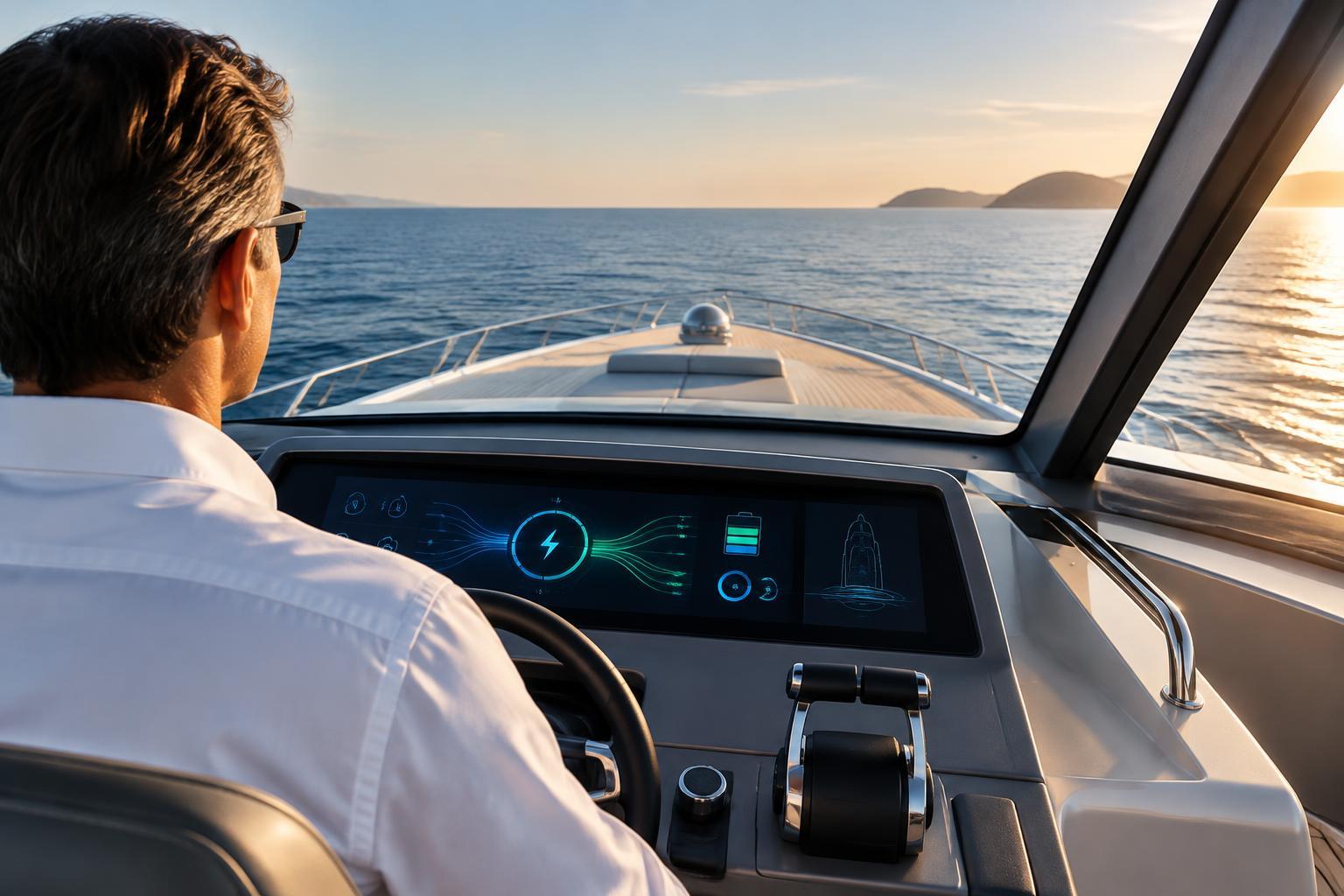
An electric yacht power management system is the control architecture that monitors available energy and directs it safely between the battery bank, propulsion motors, charging equipment and onboard loads. It gives the owner and crew a practical view of energy use while helping the vessel operate within the limits of its electrical, thermal and charging systems.
For a premium electric yacht, power management is not simply a dashboard feature. It is the coordination layer that determines how confidently the yacht can leave the berth, maintain a planned speed, supply hotel loads and retain an appropriate energy reserve for manoeuvring and return.
How power is routed around an electric yacht
Electrical energy begins in the battery bank, usually formed from multiple protected modules assembled into a high-voltage battery system. From there, power passes through switching, protection and conversion equipment before reaching the propulsion inverter. The inverter converts direct current from the batteries into the controlled electrical supply required by the motor.
At the same time, onboard services such as lighting, climate control, refrigeration, navigation electronics and domestic outlets need power at a lower voltage. A DC-DC converter reduces high-voltage battery energy to supply these auxiliary circuits, while shore-power equipment manages energy coming into the yacht during charging. The power management system supervises these paths rather than treating propulsion and hotel consumption as separate concerns.
This matters because every significant load affects the same finite energy budget. A yacht may have sufficient battery energy to complete a route at a given operating profile, but sustained use of high-demand onboard equipment can reduce the margin available for propulsion. A well-designed system makes that relationship visible and can apply defined priorities when demand becomes excessive.
The control functions that matter most
Battery protection and usable energy
The battery management system, commonly called the BMS, monitors the condition of individual cells and modules. It tracks factors including voltage, current and temperature, and it can limit charging or discharge when operating conditions approach defined thresholds. Its role is central to safety and battery longevity, but it does not by itself create a complete yacht-level energy strategy.
The wider power management system uses information from the BMS to calculate usable energy and present it in a form that supports operational decisions. A percentage state of charge is useful, but it is only one indicator. Expected range also depends on vessel speed, hull condition, sea state, wind, payload, water temperature and the electrical demand of onboard systems. For this reason, credible range prediction should be treated as a live operating estimate, not as a fixed promise.
Propulsion and hotel-load priorities
Power limits are particularly important during acceleration, sustained high-speed running and close-quarters manoeuvring. The system must allow the propulsion package to deliver requested power where conditions permit, without exposing batteries, cables, inverters or cooling circuits to unsuitable loads. It may also reduce non-essential hotel consumption when preserving propulsion capability has priority.
The correct priority logic depends on the yacht’s intended use. A day yacht, a tender and a larger cruising yacht can have very different operating patterns, accommodation demands and charging opportunities. The power-management specification should therefore follow a realistic duty cycle: how the yacht is used over a day, where it is berthed, when it can charge and what reserve the owner expects to retain.
Thermal management is part of energy management
High-performance electric propulsion creates heat in battery modules, power electronics and motors. Cooling systems keep these components within their intended operating range, but pumps, fans and chilled-water equipment also consume energy. Power management must account for this demand and respond to temperature data as conditions change.
Marine conditions add further complexity. Warm ambient temperatures, repeated acceleration, restricted ventilation and high auxiliary demand can alter the thermal load substantially. Placement of batteries, inverters, cooling lines and ventilation routes is therefore an engineering decision, not merely a packaging exercise. Weight distribution, service access, water resistance and electrical isolation must be considered alongside energy efficiency.
Charging should be planned as an operating system
Charging is most effective when it is integrated with the owner’s actual itinerary. The yacht needs compatible shore infrastructure, appropriate onboard charging hardware and controls that manage battery temperature and charging limits. Available connection capacity, berth dwell time and other loads drawing from the same shore supply can all affect the charging plan.
Owners should also consider what happens when charging is delayed or unavailable. The energy display should make reserve status easy to interpret, and route planning should reflect the conditions likely to be encountered. For a deeper review of the inputs behind route-specific energy planning, see the elements of a proper range assessment.
Specifying the right system for the yacht
A capable solution combines battery integration, propulsion controls, conversion equipment, charging interfaces, cooling supervision and an understandable helm display. It should also provide fault information that helps qualified service teams diagnose issues without overwhelming the operator with raw engineering data. Interfaces between these components are as important as the components themselves.
Before committing to a design or refit, define the expected speed profile, onboard electrical loads, charging environment, desired reserve and installation constraints. Aqualith Marine can support this process through electric propulsion development, marine battery integration, hydrodynamic optimisation and marine engineering consulting, helping align the energy architecture with the yacht’s intended operation.
Leave a Reply