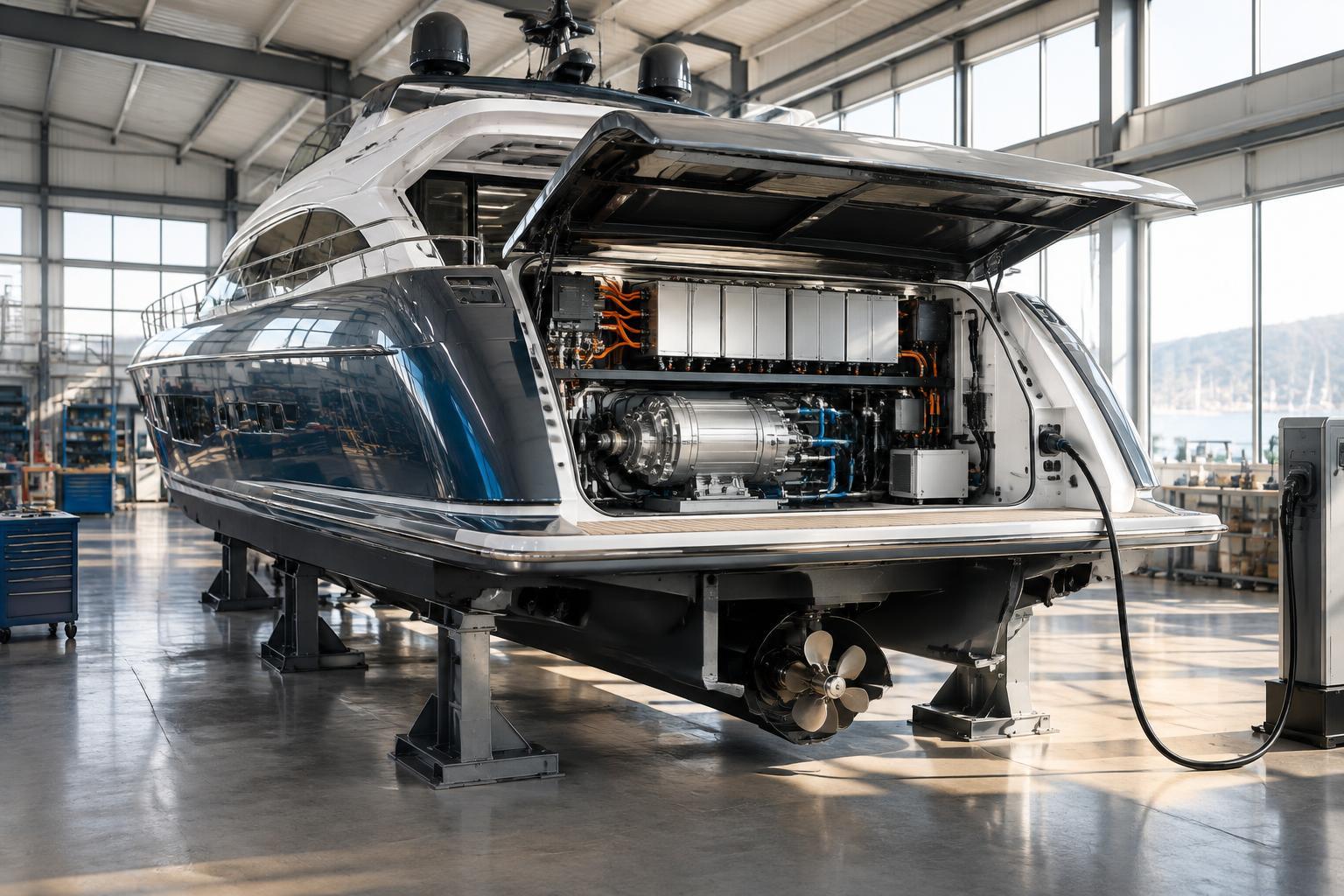
The electric yacht propulsion system cost is shaped less by a single motor price than by the complete energy and integration package required for the yacht’s intended use. Battery capacity, propulsion power, hull resistance, charging access, cooling, control systems and installation complexity all affect the final project budget.
For a credible comparison, assess costs against a defined operating profile: expected speed, time underway, manoeuvring demands, passenger load, route conditions and the charging time available between trips. Without that brief, a low initial equipment price can conceal a system that is too heavy, lacks practical range or requires costly changes later.
What is included in an electric propulsion project?
An electric yacht system normally combines energy storage, electric motors, motor controllers known as inverters, transmission or direct-drive components, propellers, high-voltage cabling, safety hardware, monitoring software and charging equipment. The cost also includes the engineering required to make these elements function as one dependable marine system rather than a collection of individual parts.
The yacht itself is a major cost driver. A new-build hull can be arranged around battery volume, weight distribution, service access and cable routes from the outset. A refit may require structural adaptations, new technical spaces, revised ventilation arrangements or upgraded electrical infrastructure. These constraints can be more influential than the nominal cost of the motor.
Battery capacity is usually the pivotal variable
Marine batteries store the energy that determines practical electric boat range, but they also occupy volume and add significant mass. A larger battery bank may support longer operation, yet it can affect trim, payload, interior layout and the charging strategy. The battery installation also needs sealed enclosures, electrical protection, battery-management controls and suitable thermal management. A battery-management system monitors cell condition and helps keep the pack within its specified operating limits.
Battery selection should therefore follow an energy model, not an assumed range target. That model should account for the yacht’s resistance through the water, anticipated speed profile, auxiliary loads and environmental conditions. Head seas, wind, hull fouling, low temperatures and sustained high-speed operation can all change energy demand.
Drive hardware must match the duty cycle
High-performance electric motors can deliver immediate torque, meaning turning force at the shaft, which is valuable for acceleration and low-speed control. However, motor size alone does not define the package cost or suitability. The inverter, reduction gear where used, propeller, cooling circuit and control calibration must be matched to the hull and operating duty cycle. A system designed mainly for quiet displacement cruising is specified differently from one intended for repeated high-load running.
Integration, cooling and charging affect the installed cost
Installation is where early engineering decisions protect both budget and reliability. High-voltage equipment requires robust isolation, sealed connections, protection coordination and clear service access. Cable routing has to accommodate vessel movement, moisture exposure, heat and the separation of power and communication circuits. Integration with onboard energy management, helm displays and smart navigation functions can add scope, but it also gives the operator clearer visibility of energy use and system status.
Cooling deserves particular attention. Motors, inverters and batteries generate heat under load, and the cooling arrangement must suit the equipment, operating temperatures and marine environment. A liquid-cooling loop, pumps, heat exchangers, hoses and control logic may be necessary. The right approach depends on the vessel architecture and cannot be priced responsibly as an afterthought.
Charging infrastructure also changes the project boundary. A yacht that returns to a consistent berth with adequate shore power can be planned differently from one moving between locations with uncertain charging availability. The local electrical supply, berth facilities and applicable marina requirements should be verified before selecting charging equipment or promising turnaround times.
A worked specification example
Consider a premium day yacht intended for regular short coastal passages, quiet harbour manoeuvring and charging at its home berth. The cost study would begin with the hull’s resistance and the desired speed profile, then establish battery capacity and allowable weight. Engineers would select motors, inverters and propellers around that load case, design cooling and charging connections, and reserve protected space for batteries and service access. If the same yacht were expected to run at high speed for extended periods or charge unpredictably away from base, the battery, cooling, charging and potentially hull-optimisation scope would change substantially.
How to build a useful budget
A useful budget separates equipment supply from vessel modifications, installation labour, engineering, commissioning and future service access. It should also identify decisions that remain open, such as final charging arrangement, battery placement or propeller configuration. This makes it easier to compare proposals on system scope rather than treating quoted totals as directly equivalent.
A structured propulsion development brief can clarify these dependencies before hardware is committed. It should describe the vessel, operating profile, available space, intended charging locations and any performance priorities, then translate them into an integrated technical concept.
Plan the cost around the yacht, not the catalogue
The most appropriate electric yacht propulsion system cost is the one that delivers the required experience without carrying unnecessary battery weight, power capacity or integration complexity. Explore Aqualith Marine projects, propulsion technologies and marine engineering services to develop a system scope around your yacht’s real operating conditions.
Leave a Reply